Korea's first science university
KAIST says it was formally founded on 16 February 1971 as the nation's first science and technology university. It started with six departments and 40 master's candidates.
KAIST · Daejeon
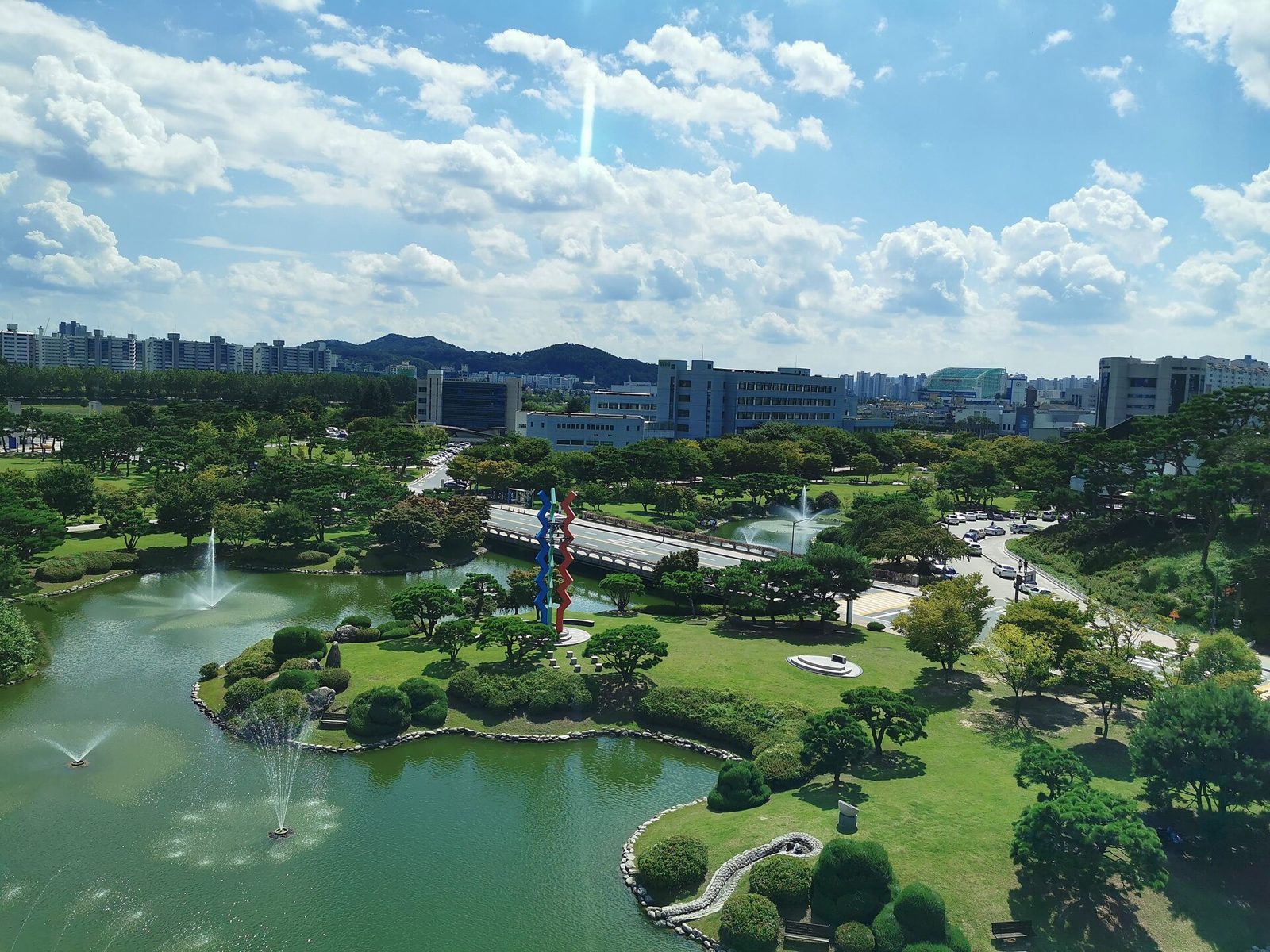
KAIST says it was Korea's first science and technology university, formally founded in 1971. Its main campus is in Daedeok Innopolis, in Yuseong-gu, Daejeon. Exchange students study and live there.
 AhmadElq, CC BY-SA 4.0, resized
Things Korean students all know that are new when you arrive.
KAIST says it was formally founded on 16 February 1971 as the nation's first science and technology university. It started with six departments and 40 master's candidates.
The main campus sits in Daedeok Innopolis, which KAIST calls Korea's largest science and technology R&D cluster. KAIST says it has three campuses, one in Seoul and two in Daejeon.
KAIST's news site calls the Duck Pond and its geese famous mascots. In 2000 Prof. Kwang Hyung Lee brought ducks from Yuseong Market and looked after them at the pond near the Carillon. Geese later took their place.
KAIST's campus-life page lists a strawberry festival in spring, the Taewool festival in summer and a science contest against POSTECH in autumn.
From KAIST's official English pages (founding philosophy, campus life), the international office's at-a-glance page and a KAIST news article on the Duck Pond, checked on 26 October 2026.
ISSS, the international student office, runs a buddy programme, counselling in English and KI House for international students.
For new undergraduate exchange students. You join a group with a Korean buddy, with a field trip, a movie night and other events early in the semester.
Country chats are for everyone from that country studying anywhere in Korea, not only at KAIST.
Going with friends? Make a group in A-CHA for your own crew and send them the invite link.
Open to every international student in Korea, not only at KAIST.
 Flash meetups. Anyone can start or join a short meetup in the app, like dinner tonight or a hike on Saturday.
Exchange students study and live on the main campus in Yuseong-gu, Daejeon. The Seoul campus isn't open to exchange students.
대전광역시 유성구 대학로 291
291 Daehak-ro, Yuseong-gu, Daejeon 34141
Also on Kakao Map and Google Maps. Naver and Kakao work best in Korea.
Every place to eat near campus.
For Spring 2027. The emails from the school come first. Use this list to check nothing is missing. Ticks stay in this browser only.
Not an official KAIST page. Dates and rules change. Check the details on KAIST's official site before you apply or book anything. KAIST exchange programme ↗ Checked on 21 October 2026
Your home university nominates you by 1 October for spring or 1 April for autumn. You then apply online from 1 September to 15 October for spring, or 1 March to 15 April for autumn, with the nomination code your coordinator gives you. Press Submit at the end, because saving isn't sending.
How to apply ↗Undergraduates need one finished year and master's students one finished semester. You need a GPA of 3.0 out of 4.3 and TOEFL iBT 80, IELTS 6.5, TOEIC 720 or B2. The English test is waived if your home university teaches in English.
Upload your transcripts in English, your English test result, a copy of a valid passport and a 3 × 4 cm photo. Students from outside the OECD also post a certificate of enrolment with an apostille or Korean consulate legalisation, and a bank statement.
For spring, the acceptance email comes in late November and the welcome package with your Certificate of Admission in early December.
Take the Certificate of Admission to the Korean embassy or consulate at home and apply for a D-2 student visa.
The dorm needs an official health form from home, with two MMR shots and a TB test result such as a chest X-ray.
National Health Insurance only starts once you have a residence number, which takes over a month. Buy travel insurance that covers at least your first month in Korea.
You need the card to open a phone contract in your own name, open a bank account and sign up for most Korean apps.
Booking the immigration visit. Papers, fee and HiKorea screens step by step. Read the guide
KAIST's spring 2026 fact sheet and the dorm rules on kds.kaist.ac.kr. Checked on 21 October 2026.
Korean universities point exchange students to these. They're private companies with no tie to any school. Don't send a deposit before you've seen the contract.
Finding a room. Browse rooms near campus in the app. If nothing fits, tell us what you need and we'll ask local agents for you, free.
The course list goes up two months before the semester and registration opens one to two months before.
KAIST tells you how once you're accepted.
About US$550 to 900
A semester, from the spring 2026 fact sheet
ISSS can give you contacts for estate agents who speak English.
Take the Certificate of Admission to the Korean embassy or consulate at home and apply for a D-2 student visa.
KAIST Buddy Program
For new undergraduate exchange students.
You join a group with a Korean buddy, with a field trip, a movie night and other events early in the semester.
Yes.
KAIST has a room on A-CHA where exchange students meet, and you can join before you land.
Register within 90 days of arriving, but KAIST strongly suggests starting as soon as you arrive.
Your school and alien registration forms are due by the second Thursday of the semester.
Exchange students with a D-2 visa must join National Health Insurance.
Cover starts only once you get your residence number.
Undergraduates take 4 to 8 courses (12 to 24 credits) and master's students 3 to 4 courses (9 to 12 credits).
You can take fewer if your home university allows it.
Your home university nominates you by 1 October for spring or 1 April for autumn.
You then apply online from 1 September to 15 October for spring, or 1 March to 15 April for autumn, with the nomination code your coordinator gives you.
Press Submit at the end, because saving isn't sending.
 Netherlands
 Germany
 France
 Spain
 Italy
 Sweden
 Finland
 Poland